
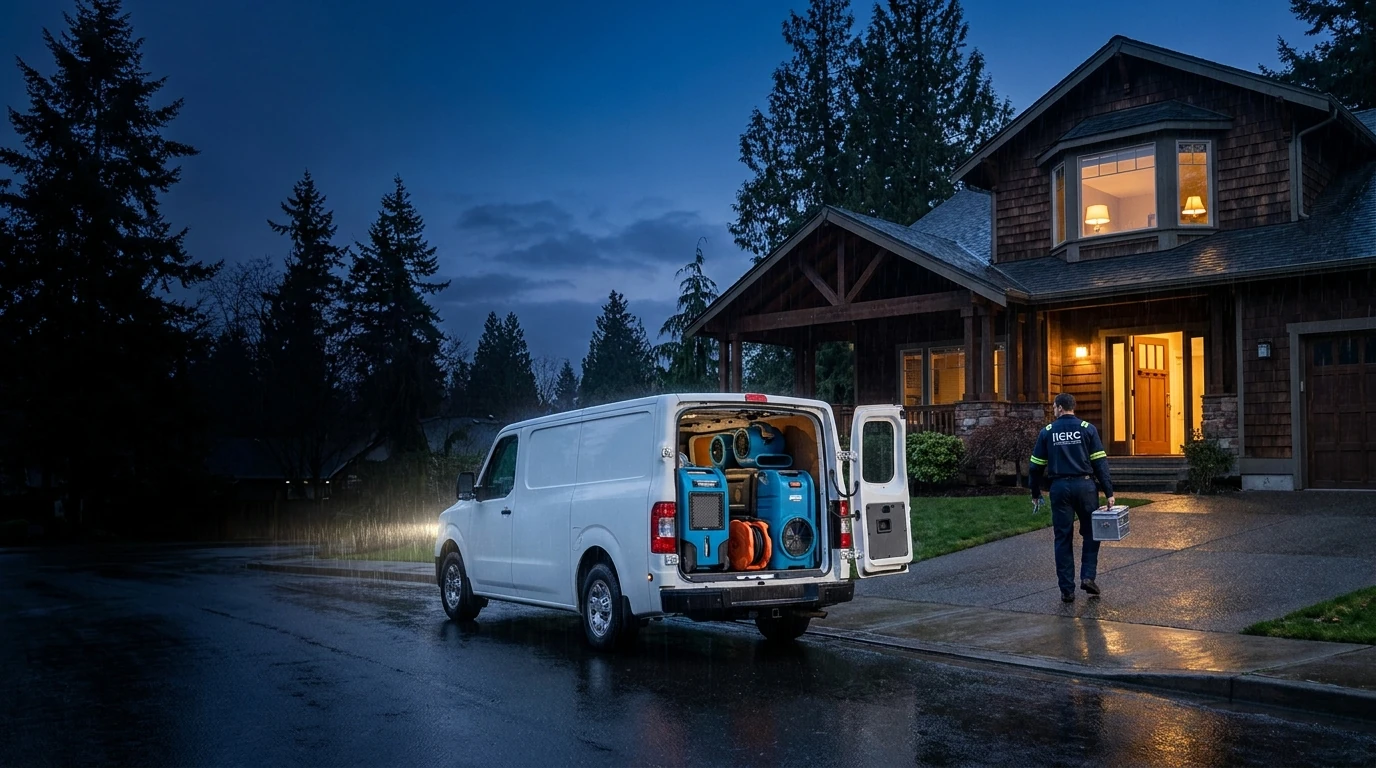
If water is actively entering your home right now, start here: shut off the main water supply valve, cut power to any flooded rooms at the breaker panel, and get everyone — including pets — out of standing water. The decisions you make in the next few hours will determine whether you’re dealing with a manageable cleanup or a months-long reconstruction project. Mold can begin colonizing wet building materials in as little as 24 to 48 hours, and structural damage compounds quickly once water finds its way into subfloors, wall cavities, and insulation.
Step One: Stop the Source and Make It Safe
Before anything else, the water has to stop moving. If a pipe burst or an appliance line failed, your main shutoff valve is usually located where the water line enters the house — in Federal Way and most of the South Sound region, that’s often in a utility closet, crawl space, or garage. Turn it clockwise until it stops. If you’re on a well, shut off the pump breaker instead.
Once the source is controlled:
- Cut power to affected rooms. Water and live circuits are a fatal combination. If you can’t reach your breaker panel without walking through standing water, call an electrician or your utility (Puget Sound Energy serves most of Federal Way) before re-entering.
- Open windows and interior doors if outdoor air is drier than indoor air — common in Pacific Northwest summers, less so in winter. Air movement slows secondary damage.
- Document everything before you touch it. Walk through with your phone and shoot video of every affected room, every water line, every stain on the ceiling. Your insurance adjuster will want this, and photos taken after cleanup are nearly worthless for a claim.
If the water came from a sewage backup, a toilet overflow, or a flooded crawl space with standing groundwater, treat it as contaminated. Don’t wade through it, and don’t let children or pets near it.
What to Do in the First Two Hours
Once the source is stopped and the space is safe to enter, work fast. Water moves faster than most people expect — it wicks upward through drywall at roughly an inch per hour and travels horizontally under hardwood flooring before you can see it at the surface.
- Remove standing water with whatever you have. Wet/dry vacuums, mops, and towels all work for small volumes. For anything more than a few gallons, you need a submersible pump or extraction equipment.
- Pull up area rugs and move furniture off wet carpet. Furniture legs wick water upward into upholstery and leave rust or dye stains on carpet that are nearly impossible to remove later. Place aluminum foil or plastic bags under legs if you can’t move a piece entirely.
- Get air moving. Box fans pointed toward wet surfaces and a dehumidifier running continuously will slow the damage. In Western Washington’s humid climate, a standard household dehumidifier is often not powerful enough — professional units pull 30 to 50 gallons of water per day from the air versus a residential unit’s 2 to 3.
- Call your homeowner’s insurance carrier. Most policies require you to report damage promptly and take reasonable steps to prevent further loss. Document that call — note the date, time, and the claim number they give you.
- Check adjacent rooms and the floor below. Water follows gravity and finds every gap. If the damage is on a second floor, press your hand against the ceiling below — if it feels soft or warm, water is already pooling above the drywall.
What Not to Do
Some of the most common instincts after a flood actually make things worse.
- Don’t run your HVAC system. Forced-air heating and cooling spreads moisture — and any mold spores already present — through your ductwork and into rooms that weren’t affected.
- Don’t use a standard household vacuum on standing water. They’re not designed for it and can create an electrocution hazard.
- Don’t assume it’s dry because the surface feels dry. Hardwood floors can look fine while holding significant moisture in the subfloor beneath. Drywall that feels dry to the touch can still read 20–30% moisture content on a meter. The only way to know is to measure.
- Don’t throw away damaged materials before your adjuster sees them — or before you’ve photographed them thoroughly. Insurers sometimes deny claims when they can’t verify the scope of loss.
- Don’t wait on mold. If you can smell that earthy, musty odor within the first day — the smell that’s somewhere between wet soil and old paper — mold is already growing. Visible mold is a later-stage symptom, not the beginning.
When to Call a Professional Restoration Company
Some water damage situations are genuinely DIY-manageable: a small appliance leak caught in an hour, a bathroom floor that got wet but dried quickly, a window left open during a light rain. If the affected area is less than about 10 square feet, the water was clean, and you dried it within a few hours, you may be fine with fans and a dehumidifier.
Call a professional restoration company when:
- The water has been sitting for more than a few hours, or you don’t know how long it’s been there
- The source was a sewage line, toilet, or groundwater intrusion (Category 2 or Category 3 contamination in industry terms)
- You can see or smell mold already
- The water reached wall cavities, subfloors, or insulation
- The affected area is larger than one room
- Your home was built before 1980 and may contain asbestos or lead paint in materials that got wet
IICRC-certified water damage technicians carry moisture meters, thermal imaging cameras, and industrial drying equipment that can locate water hidden behind walls and under floors — damage that looks minor from the surface but can cost tens of thousands of dollars if it’s missed and left to fester through a Western Washington winter.
The Longer Recovery: What Happens After the First Day
Professional water damage restoration typically unfolds in phases over several days to weeks, depending on the scope. After extraction and initial drying, technicians set drying equipment — air movers and commercial dehumidifiers — and monitor moisture readings every 24 hours. Structural drying to industry standards (below 16% moisture content in wood framing, for example) usually takes three to five days under controlled conditions.
If materials like drywall, insulation, or flooring absorbed too much water to dry in place, they’ll need to be removed — a process called demolition or “demo” — before reconstruction can begin. This is also when any mold remediation happens, if mold has already taken hold.
Reconstruction — replacing drywall, flooring, trim, and paint — follows once everything is confirmed dry and clean. A full-service restoration contractor handles the entire sequence, which matters for insurance billing: one company, one scope of work, one point of contact with your adjuster.
If you’re in Federal Way or the surrounding South Sound area and the situation is beyond what fans and towels can handle, National Restoration Construction responds 24 hours a day. A quick call to (206) 883-0333 gets a technician on-site to assess the damage and walk you through next steps — including what your insurance should cover — before anything gets worse.