Most water damage restoration takes 3 to 5 days for drying alone — but the full process, from the moment a technician arrives to the day your walls are repainted and your floors are reinstalled, typically runs 1 to 4 weeks. That range isn’t vague hand-waving. It reflects real variables: how long the water sat before anyone noticed, what materials got wet, whether mold started growing, and how deep the moisture traveled into structural layers. A burst pipe caught within an hour looks nothing like a slow refrigerator leak discovered two weeks later behind the kickplate.
Why the Timeline Varies So Much
Water doesn’t stay where it lands. Within minutes, it wicks into drywall, travels along subfloor seams, and soaks into insulation you can’t see. The longer it sits, the deeper it goes — and the longer it takes to reverse.
Restoration professionals use a classification system that shapes every timeline estimate:
- Category 1 (clean water): A broken supply line or overflowing sink. Fastest to remediate, lowest contamination risk.
- Category 2 (gray water): Washing machine overflow, dishwasher discharge, or aquarium leaks. Contains microorganisms and mild contaminants.
- Category 3 (black water): Sewage backups, floodwater from outside, or any Category 1/2 water that sat long enough to become biologically active. Requires full protective protocols and takes significantly longer.
The affected materials matter just as much. Hardwood floors can sometimes be dried in place over 5 to 7 days with aggressive equipment. Wet fiberglass insulation inside a wall cavity almost always needs to come out — there’s no practical way to dry it in place. Concrete slabs can hold moisture for weeks even after surface drying looks complete.
In the Pacific Northwest, Federal Way’s climate adds one more factor: ambient humidity. When outdoor relative humidity sits above 60% — which is most of the year west of the Cascades — drying equipment has to work harder and run longer than it would in a drier climate like Eastern Washington or Arizona.
The Typical Restoration Timeline, Phase by Phase
Here’s how the process usually unfolds from the first call to the final walkthrough:
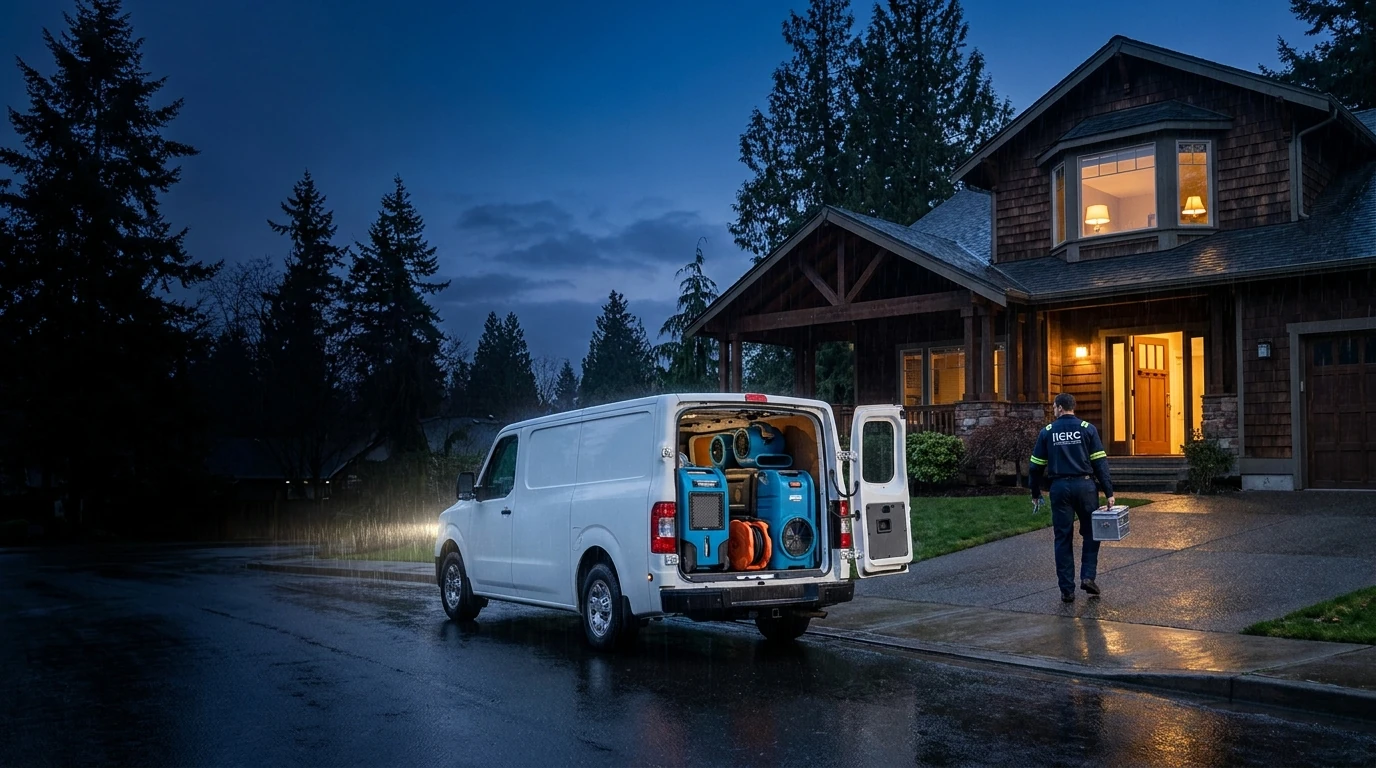
Day 1 — Emergency response and assessment A technician arrives, identifies the water source, and stops active intrusion if it hasn’t been stopped already. Moisture meters and thermal imaging map how far the water traveled. Depending on the category, standing water is extracted with truck-mounted or portable units. Industrial air movers and dehumidifiers go into place before the technician leaves.
Days 2–5 (or longer) — Structural drying This is the phase most homeowners underestimate. Equipment runs continuously, 24 hours a day. A technician returns daily to take moisture readings and adjust equipment placement. The goal is to bring all affected materials down to pre-loss moisture levels — not just “dry to the touch.” Drywall that feels dry on the surface can still read 18–22% moisture content inside the wall cavity. Anything above roughly 16% is a mold risk.
If readings aren’t dropping fast enough, controlled demolition happens here: baseboards come off, sections of drywall are removed to expose cavities, or flooring is pulled up to dry the subfloor beneath. This isn’t damage — it’s the only way to dry materials that equipment can’t reach through finished surfaces.
Days 3–7 — Mold assessment and treatment (if needed) Mold can begin colonizing wet organic material in as little as 24 to 48 hours under the right temperature and humidity conditions. If the water sat before anyone noticed, or if the job involves Category 2 or 3 water, a mold assessment happens alongside drying. Treatment — which may include HEPA vacuuming, antimicrobial application, and containment — adds time but is not optional if mold is present.
Week 2 and beyond — Reconstruction Once all materials pass final moisture verification, reconstruction begins: new drywall, insulation, flooring, paint, trim. This phase runs on a contractor schedule, which means it depends on material availability, permit requirements (sometimes needed for structural work), and subcontractor availability. A straightforward drywall patch and repaint might take two days. A bathroom with tile, a vanity, and a subfloor replacement might take two to three weeks.
What Slows Everything Down
Some delays are unavoidable. Others are preventable.
Hidden moisture is the most common reason a job runs long. If a technician closes out a job before a wall cavity or subfloor reads dry, moisture migrates back into finished surfaces and mold follows. Reputable contractors won’t sign off until readings confirm complete drying — even if that means running equipment for a ninth or tenth day.
Insurance documentation can add days at the front end. Adjusters need to inspect before demolition in some cases, or require a scope of work before authorizing repairs. An experienced restoration contractor knows how to coordinate this without leaving wet materials sitting while paperwork catches up.
Secondary damage discovered mid-job — rot in a subfloor joist, corroded pipe fittings behind a wall, asbestos-containing texture in a pre-1980s home — can pause work while additional specialists are brought in.
Homeowner decisions also affect the clock. Choosing new flooring that’s backordered, or deciding mid-project to expand the scope of repairs, adds time that has nothing to do with the water damage itself.
What You Can Do Before a Contractor Arrives
If you’re dealing with an active situation right now, these steps reduce damage and shorten the eventual restoration timeline:
- Stop the source. For a burst pipe, turn off the main water shutoff. For an appliance leak, pull the supply line. For a roof intrusion, get a tarp over the affected area if it’s safe to do so.
- Remove standing water manually if you can. Towels, a wet/dry shop vac, or a mop — anything that reduces saturation time matters. Don’t use a standard household vacuum.
- Move furniture and belongings off wet flooring. Upholstered furniture sitting in water becomes a secondary contamination source quickly.
- Open interior doors and run ceiling fans to improve air circulation — but don’t run HVAC if you suspect the system itself got wet.
- Document everything with photos and video before touching anything. Your insurance claim will thank you.
What you should not do: run a residential dehumidifier and assume the job is done. Consumer-grade dehumidifiers remove roughly 30–70 pints of moisture per day. A single commercial LGR dehumidifier used in professional restoration removes 150+ pints per day and is calibrated to the specific grain depression needed for structural drying. The difference between the two is often the difference between a clean dry-out and a mold problem three weeks later.
When the Job Is Bigger Than a DIY Fix
If the affected area is larger than about 10 square feet, involves Category 2 or 3 water, has been wet for more than 24 hours, or includes any structural materials — subfloor, wall framing, ceiling joists — professional equipment and documentation aren’t optional extras. They’re what separates a resolved claim from a recurring problem.
For Federal Way homeowners and property managers dealing with water damage right now, National Restoration Construction responds to emergency calls at (206) 883-0333. The team is IICRC-certified, works directly with insurance carriers, and can typically have equipment on-site the same day. If you’re still in the research phase and not sure whether your situation warrants a call, the answer is almost always yes — a moisture assessment costs you nothing but time, and it tells you exactly where you stand.