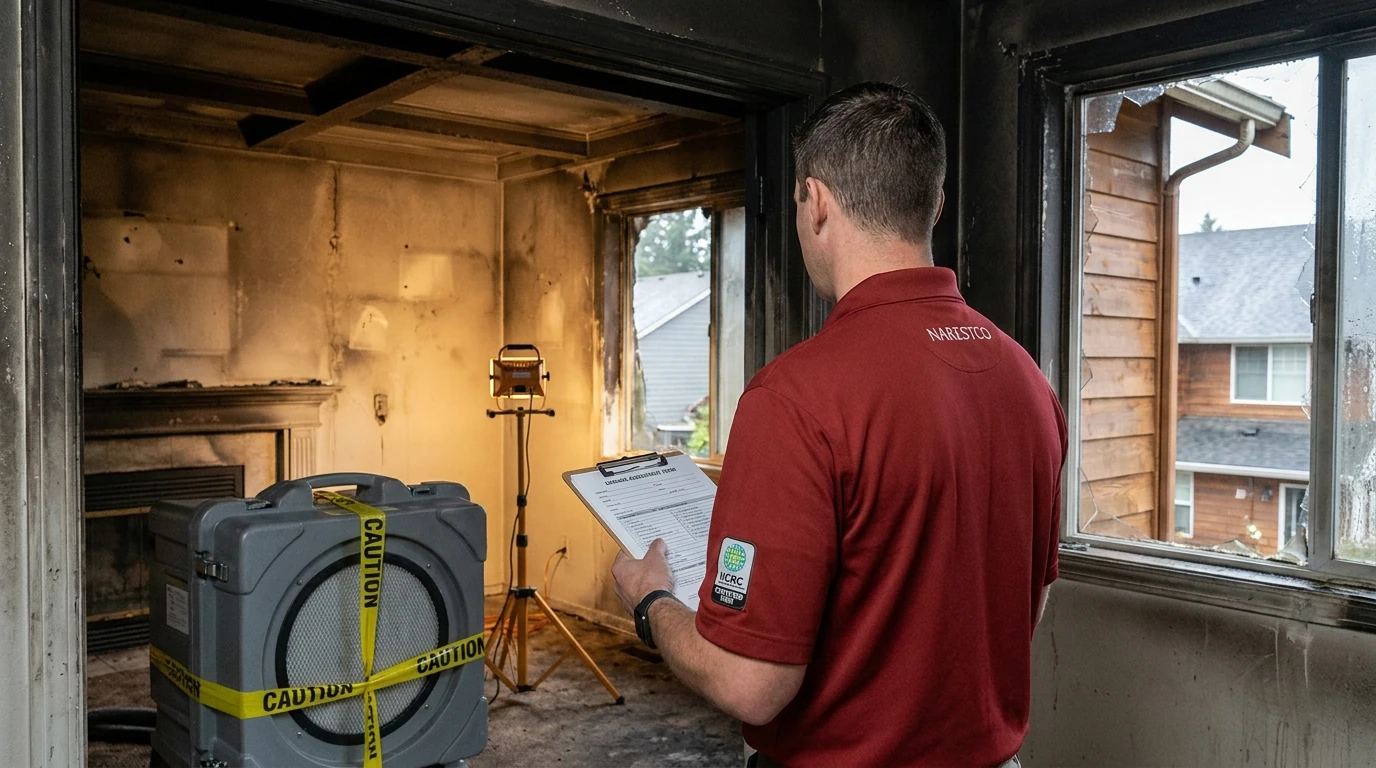
You’re standing outside your home, the smoke has cleared, and the fire department is packing up. Everything you know about the next steps feels uncertain. The first 72 hours after a house fire are the most consequential for your insurance claim, your health, and your home’s structural future. This guide walks through each phase in order, so you’re not guessing.
Before You Go Back Inside
Do not re-enter until the fire department explicitly clears the structure. This isn’t a formality. After a fire, floors may look intact but have compromised joists underneath. Walls hold heat long after visible flames are out. The fire marshal or incident commander will tell you when re-entry is safe, and that clearance should be in writing if possible.
If you have pets or medications inside, ask a firefighter to retrieve them. Do not go in yourself.
Once cleared, limit your time inside to documentation only. Soot is not just a cosmetic problem. It contains carbon particles, heavy metals, and volatile organic compounds. Breathing it without an N95 respirator causes real harm. If you have one, wear it. If you don’t, get in and get out.
Hour 1-4: Document Everything Before Touching Anything
Your insurance adjuster will want evidence of the pre-remediation state. The single biggest mistake homeowners make after a fire is cleaning up before documenting. Once you disturb soot or move damaged contents, you lose the baseline your claim depends on.
Here’s how to document effectively:
- Photograph every room from the doorway before stepping in, then from multiple angles inside. Shoot the ceiling, the walls, the floors, the contents.
- Video walkthrough is even better. Narrate what you’re seeing. “This is the living room, the couch is fully charred, the TV is melted, the ceiling has active soot deposition.” Timestamps matter.
- Open cabinets and closets and photograph inside. Smoke infiltrates everywhere, including rooms that weren’t near the fire. A bedroom at the far end of the house may have smoke-damaged clothing and electronics that are compensable.
- Photograph serial numbers and model numbers on appliances, electronics, and HVAC equipment before anything is moved.
- Don’t throw anything away yet. Even items that look destroyed may be on your contents inventory. Adjusters sometimes want to inspect items before approving replacement value.
If your phone was damaged in the fire, borrow one. This documentation step is worth more than almost anything else you’ll do today.
Hour 4-12: Contact Your Insurance Company
Call your homeowner’s insurance carrier as soon as you have documentation started. Most policies require “prompt notice” of a loss, and waiting more than 24-48 hours can create complications, though it rarely voids a claim outright.
When you call, have ready:
- Your policy number
- The address and a description of what happened
- Whether the fire department responded (they will have a report number)
- Your documentation (photos/video) ready to send
Ask your adjuster these specific questions:
- What is my Additional Living Expenses (ALE) coverage limit, and does it start immediately?
- Do I need to use your preferred vendors, or can I choose my own restoration contractor?
- What is the process for contents inventory, and do I need to list every item?
- Will you cover emergency board-up and tarping if the structure is exposed?
ALE coverage is important to understand immediately. Most standard homeowners policies (HO-3) cover temporary housing, meals above your normal food costs, and other living expenses while your home is uninhabitable. This coverage has a dollar limit and sometimes a time limit. Activate it now.
On vendor choice: you are generally not required to use an insurance-preferred vendor. You have the right to select your own licensed restoration contractor. The insurer pays based on a written scope of work, not on which company you choose.
Hour 12-24: Secure the Structure
If the fire caused structural openings, broken windows, or a compromised roof, the structure needs to be secured before the next rainfall or overnight temperature drop. In the Pacific Northwest especially, an unsecured fire-damaged home can develop secondary water damage within hours.
Emergency board-up and tarping is typically covered under your homeowners policy as a “protective measures” expense. Document the cost and keep all receipts.
A licensed restoration company can handle this as part of their initial response. They’ll assess structural safety, install plywood over openings, tarp exposed roof areas, and set up any necessary temporary shoring. This is not the same as beginning full restoration, and it does not commit you to that contractor for the full project.
What to Throw Out (and What to Keep)
This is one of the most searched questions after a fire, and the answer is more nuanced than most people expect.
Throw out immediately (do not attempt to clean or salvage):
- Any food, including canned goods, that was in the fire zone. Heat compromises canned goods even without visible damage. Smoke and soot contaminate open food, spices, and anything not in an airtight container.
- Medications that were exposed to heat or smoke. Pharmaceutical compounds degrade unpredictably under heat stress.
- Cosmetics and personal care products that were in the fire area.
- Anything with visible char that is structurally compromised.
Do not throw out yet (document first, then consult your adjuster):
- Electronics. Many fire-damaged electronics look destroyed but are on your contents list. Photograph them, note model and serial numbers, and let your adjuster inspect before disposal.
- Furniture and textiles. Some upholstered furniture can be professionally cleaned; some cannot. A restoration company can assess this. Throwing it out before the adjuster sees it may reduce your settlement.
- Clothing. Soot-contaminated clothing can sometimes be restored by professional textile cleaning. Even if it can’t, it needs to be on your contents inventory.
The general rule: photograph before you discard, and consult your adjuster or restoration contractor before discarding anything of significant value.
Hour 24-72: Engage a Restoration Contractor
Fire damage restoration is not a DIY project. The reasons are technical, not just practical.
Soot is acidic. Dry soot residue (from fast-burning synthetic materials) begins etching surfaces within hours. Wet soot (from slow-burning organic materials) is stickier and penetrates porous surfaces deeply. The IICRC S700 standard for fire and smoke damage restoration classifies residues by type because the cleaning chemistry and methods differ significantly. Wiping soot with a damp cloth typically spreads it and drives it deeper into porous surfaces.
Smoke odor is not a surface problem. Smoke particles are 0.1 to 4 microns in size. They penetrate drywall, insulation, subflooring, and HVAC ductwork. Masking odor with sprays or paint without addressing the underlying contamination will result in odor returning within weeks. Professional smoke damage restoration uses thermal fogging, hydroxyl generators, or ozone treatment in combination with HEPA air scrubbing to address odor at the particle level.
A qualified restoration contractor will provide a written scope of work that your insurance adjuster can review and approve. This scope should include:
- Structural assessment and stabilization
- Contents inventory and pack-out (if needed)
- Soot and smoke residue removal by surface type
- Odor treatment protocol
- HVAC inspection and cleaning
- Moisture assessment (firefighting water creates secondary damage)
- Reconstruction scope if structural elements need replacement
For homes with significant structural damage, reconstruction services may be needed after remediation is complete. A contractor who handles both remediation and reconstruction can coordinate the full project under one scope, which simplifies the insurance claim process.
How Long Does Fire Damage Restoration Take?
The honest answer: it depends on scope, but here are realistic benchmarks.
- Minor fire (one room, limited smoke spread): 1-2 weeks for remediation, plus reconstruction time if drywall or flooring needs replacement.
- Moderate fire (multiple rooms, significant smoke infiltration): 3-6 weeks for remediation. Reconstruction adds 4-12 weeks depending on what’s affected.
- Major fire (structural damage, large area involved): 3-6 months total is common. Complex insurance claims, structural engineering review, and permit requirements all extend the timeline.
The restoration timeline is also affected by how quickly you start. Soot begins etching metal surfaces within hours. Smoke odor compounds become harder to neutralize after 48-72 hours of dwell time. Starting the restoration process within the first 24-48 hours after clearance is not urgency for its own sake, it genuinely affects outcomes.
The One Thing Most Homeowners Get Wrong
They try to clean up themselves before the adjuster has seen the damage. It’s an understandable instinct. The home is yours, it looks terrible, and doing something feels better than waiting. But disturbing soot, discarding contents, or beginning cleanup before documentation and adjuster inspection can reduce your settlement, complicate your claim, and in some cases void coverage for specific items.
Document first. Call your insurer. Then call a restoration company. In that order.
National Restoration Construction handles fire damage restoration from initial emergency response through full reconstruction. If you need a written scope for your insurance claim or an assessment of what’s salvageable, request a fire damage assessment at (206) 883-0333.